
Minds Unraveling
Louie Cordero exposes the horrors of online content sludge in solo show, Brain Rot.
Words Madeleine O. Teh
Photos courtesy of Louie Cordero and Finale Art File
January 02, 2026
Introduction
In 2024, the University of Oxford named “brain rot” as the word of the year.
“Brain rot,” which refers to the “deterioration of one’s mental and intellectual state” caused by overconsumption of unchallenging material, gained popularity amid the rise of so-called low-quality online content found on social media. Around 16,000 TikTok videos are uploaded every minute. Though no definitive criteria for low-quality content exists, symptoms of brain rot include shortened attention spans and mental exhaustion.
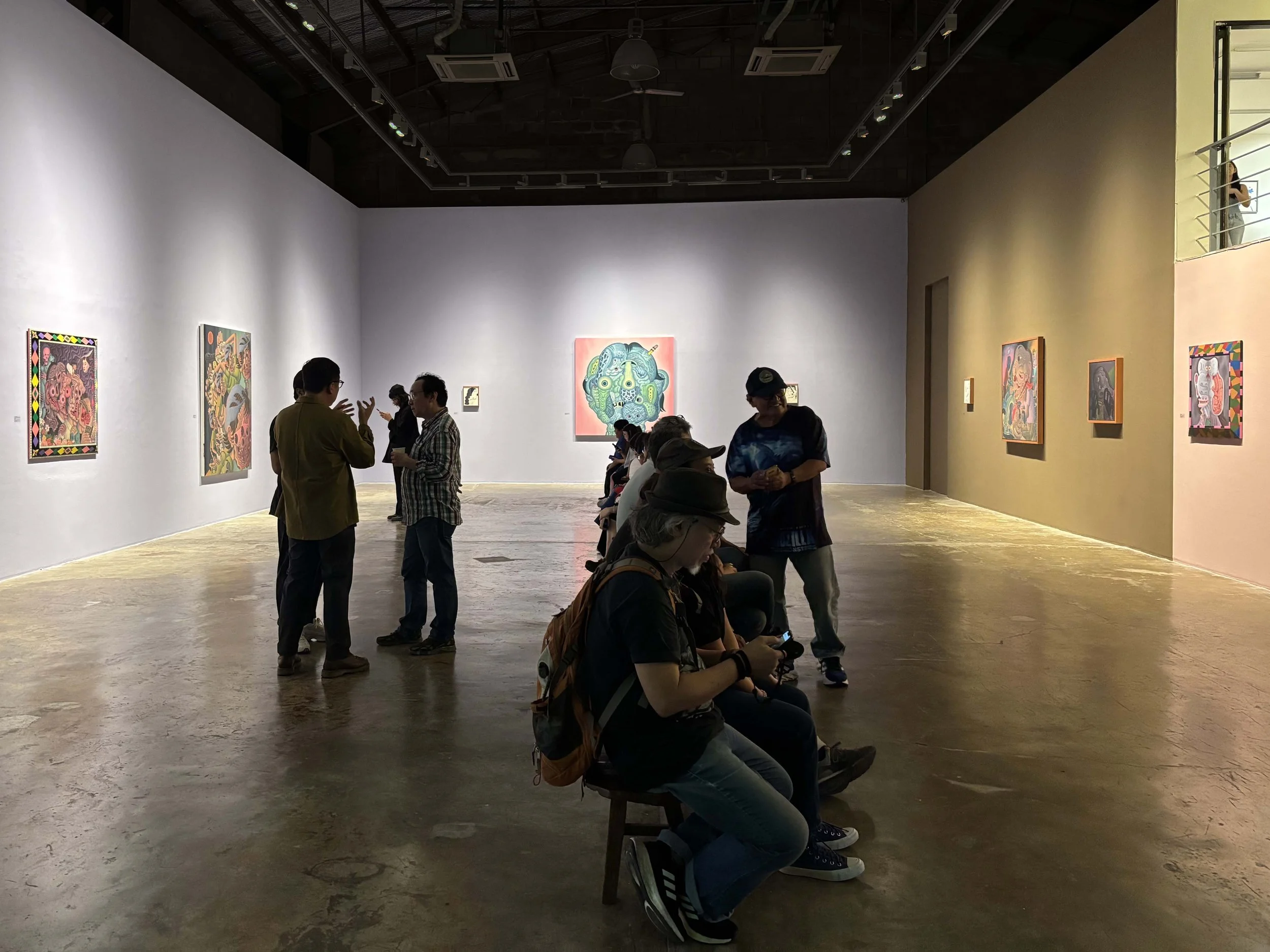
In his latest solo show, Brain Rot, artist Louie Cordero captures the abysmal effects of the endless algorithmic scroll through a series of paintings. The exhibition runs from November 7 to 29, 2025 in Finale Art File.
“Brain Rot” by Louie Cordero at Finale Art File | Photo courtesy of Finale Art File
Cordero, a veteran in Manila’s art scene and creator of cult classic comic “Nardong Tae,” blends pop culture, horror movies, and kitsch in his signature grotesque and colorful visual language. The artist uses subjects such as mutated faces and burning wastelands to critique culture at large, from generic Internet echo chambers to Philippine history.
While “brain rot” focuses on digital content, the term evokes a visceral degradation of organic matter. This contrast provides Cordero a perfect playground to get his hands dirty—guts, brains, and all.
The scenes
Brain Rot greets visitors the moment they step into Finale Art File. Fourteen acrylic paintings and seven marker illustrations hang on walls painted green, lilac, and white. While nine of these paintings and all of these illustrations are of grotesque portraits, it’s the five paintings of dizzying scenes that immediately arrest visitors.
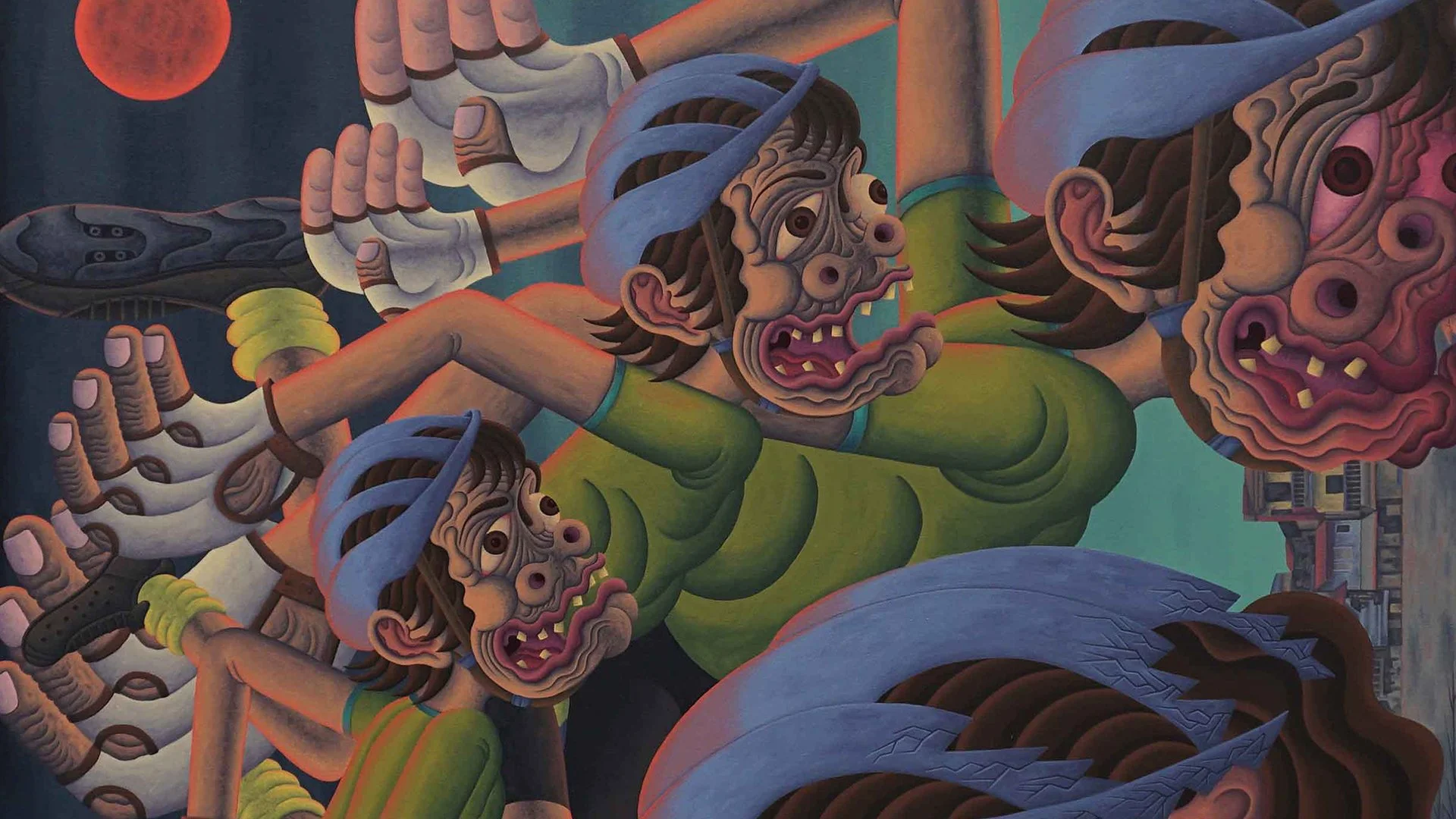
Cordero’s standout piece in the exhibition, “Pedaler descending a pavement no. 2,” depicts one biker, frantic and with eyes gauged, cycling through the entire composition. Cordero takes a cue from Futurists like Giacomo Balla and paints the singular cyclist in different stages, much like an animation cycle. This choice—a departure from his more static approach—grounds the work in the context of technological innovation and frenzy, which encapsulates the spirit of Brain Rot.
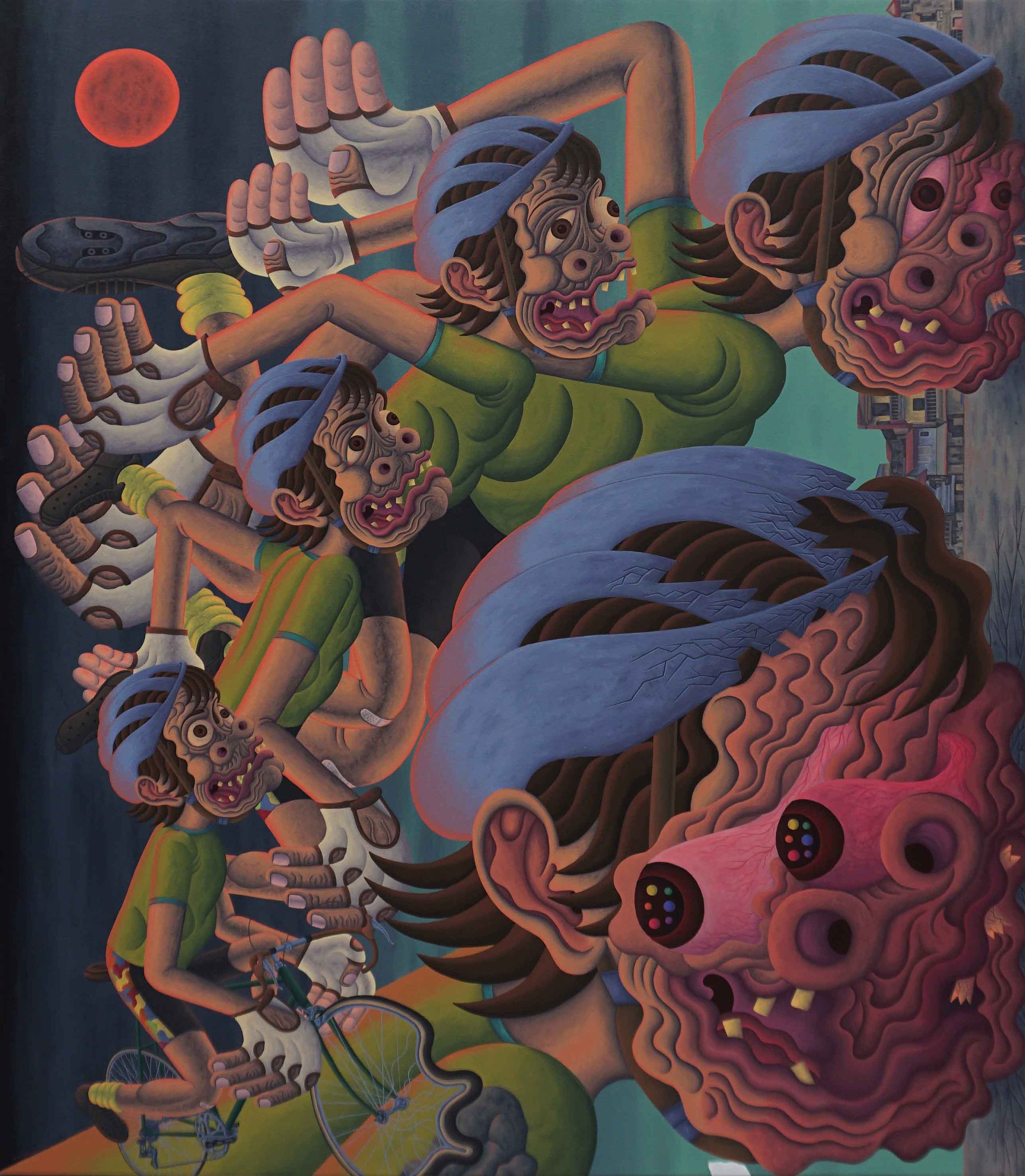
“Pedaler descending on pavement no. 2” by Louie Cordero. Acrylic on canvas. 72 x 60 inches, 183 x 152 cm
Along the gallery walls, and interspersed with portraits, lie the other scene paintings. “Ego death crisis” and “The Omnibus (the light that has lighted the world” portray the mind-numbing effects of passive work and consumption. For the former, it’s assembly-line labor and, for the latter, rote memorization in school. The appearance of a man with a tonsure suggests that this would be a religious education setting. These paintings put brain rot into a wider context of weary, contemporary life amid technology.
“A machinist holding the cosmic egg in 1986,” shows a man with a wrench walking hunched over while holding a behemoth of metal pipes behind him. Scattered around the composition are symbols of power and religion: a television, the image of Christ on the t-shirt, a black cat, a paperback. These allude to the relationship between systemic power and the flow of information, though not explicitly explored. To a lesser extent, Cordero’s “Culture of corruption, which shows a giant extending its hands to the sea, speaks to the idea of dominion and power.
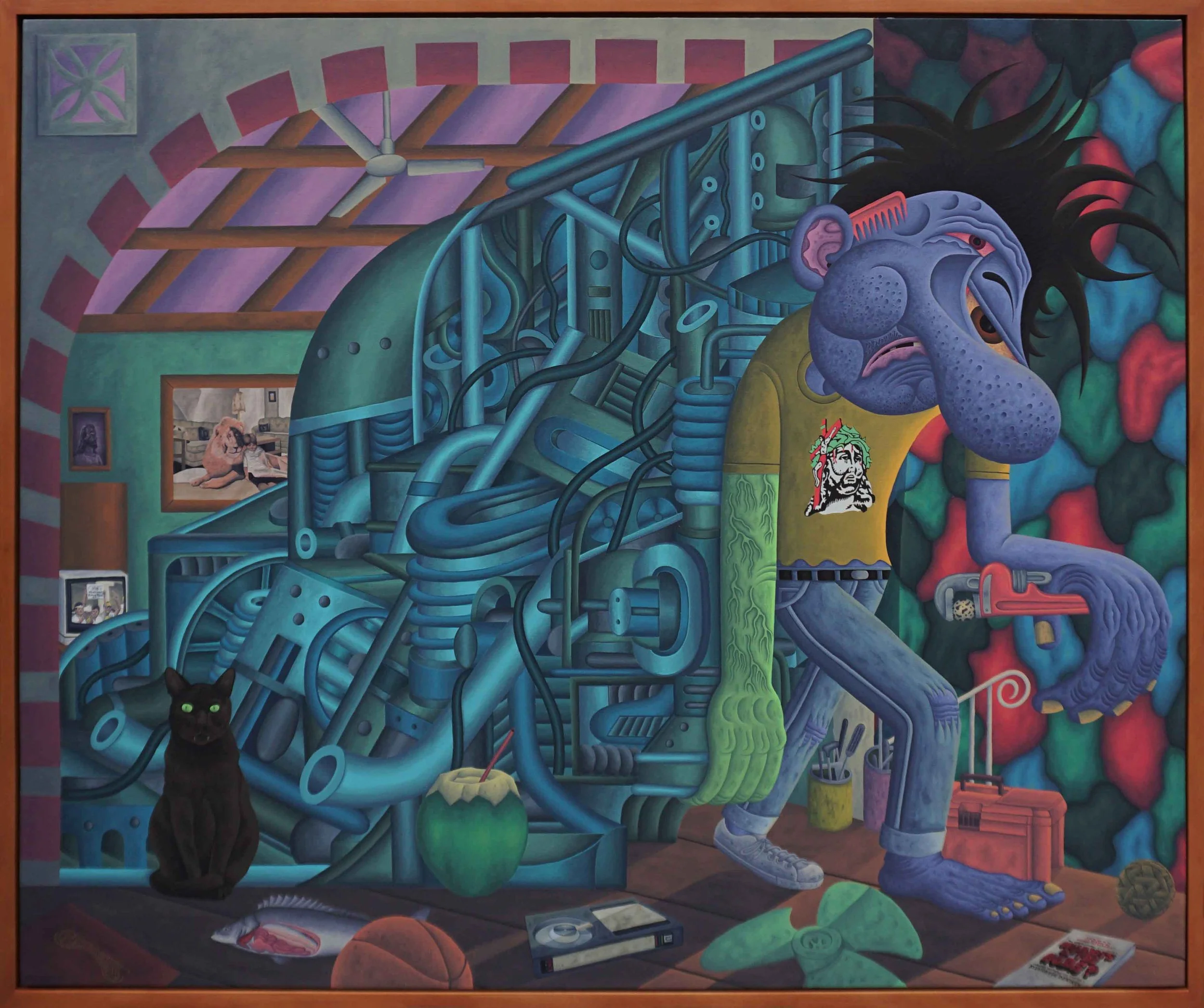
“A machinist holding the cosmic egg in 1986” by Louie Cordero. Acrylic on canvas. 60 x 72 inches. 152 x 183 cm.
Threading Cordero’s practice
Cordero’s scenes in Brain Rot are reminiscent of his work, “The Choice,” which was exhibited in MO_Space in 2023. “The Choice” depicts a person, overwhelmed with too many eyes, looking into the void of a screen. Arguably, this painting signals an evolution in Cordero’s practice by incorporating the digital space in his otherwise visceral world.
What makes “The Choice” compelling is its straightforwardness. It’s unapologetic in its exaggeration of the doomscroller, and hence, its connection with horror and kitsch.
“Kitsch denotes an accidental style or mode that often connotes tackiness and tastelessness,” Ed Simon writes in the article “In defense of kitsch.” Simon adds that kitsch is “the direct product of a capitalist commodification that cares nothing for aesthetics beyond profit.” Here, Cordero’s incorporation of kitsch works because it implies a lack of discernment when faced with the algorithmic onslaught of content from technology conglomerates.
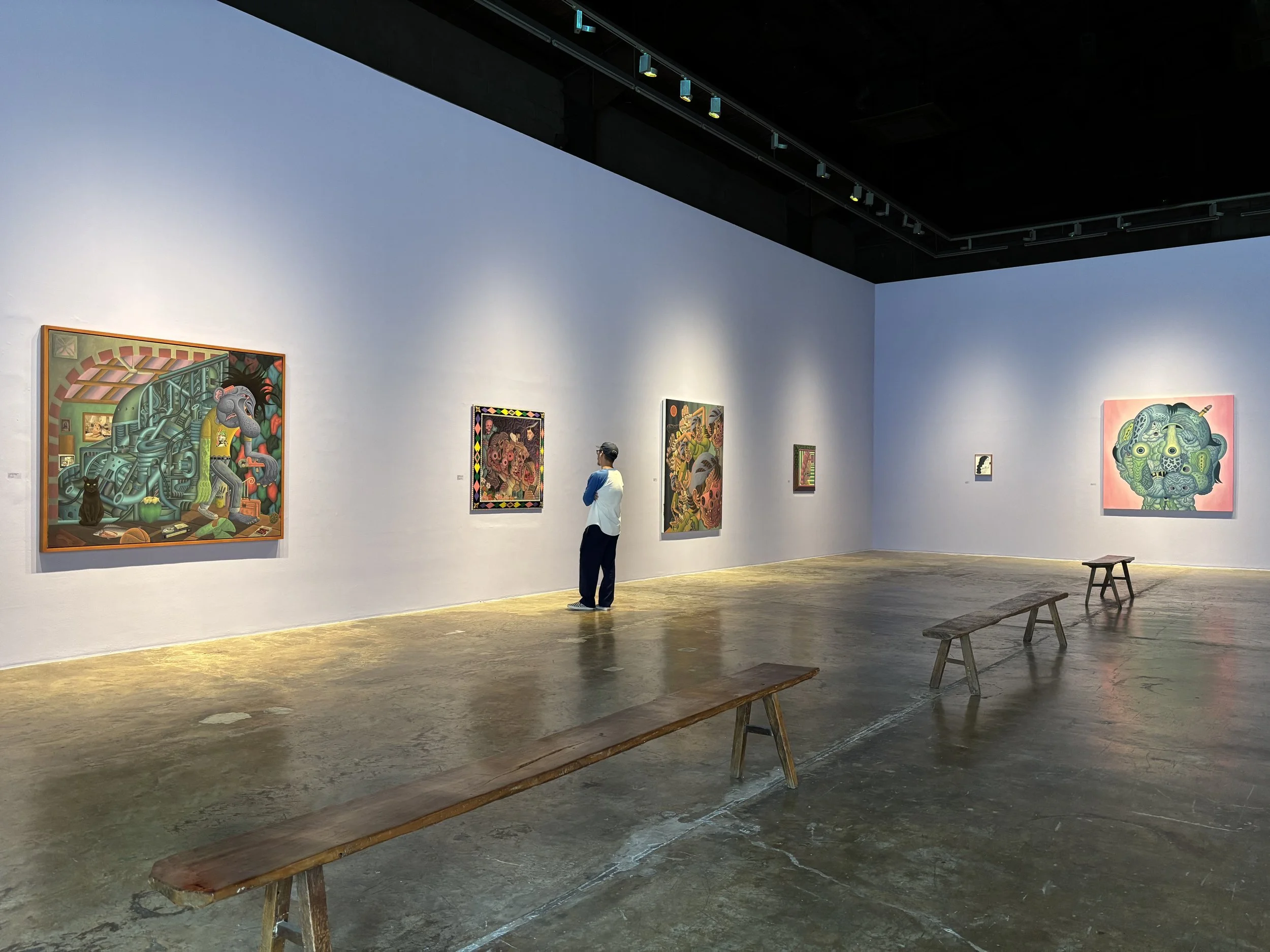
“Brain Rot” by Louie Cordero at Finale Art File | Photo courtesy of Finale Art File
Experiments in subtlety and allusions have some payoffs. Cordero’s borrowing from the Futurists in “Pedaler descending a pavement no. 2” also ties into the nature of comics and sequential art. “First, comics can be seen as a response to the process of modernization,” writes Ian Gordon in “Mass Market Modernism: Comic Strips and the Culture of Consumption.” “...and second, as a humor-based response to the problems of representation faced by a society in transition.” This painting bridges Cordero’s existing practice and prescient questions in culture.
The portraits
In addition to the five paintings of scenes, Cordero mounts nine portraits rendered in his signature vibrant style. He somehow distorts loose skin and guts through almost Cubist sensibilities.
The most striking one is a large-scale portrait, “Blasé,” which shows a lone character, with brains and other bodily fluids oozing out. A number two pencil is jammed into his head. In the exhibition text, Ricky Torre describes this character as “content to go with the flow and has surrendered itself to a kind [of] mutation in order to adapt to civilization’s own confused and hollow devolution.”
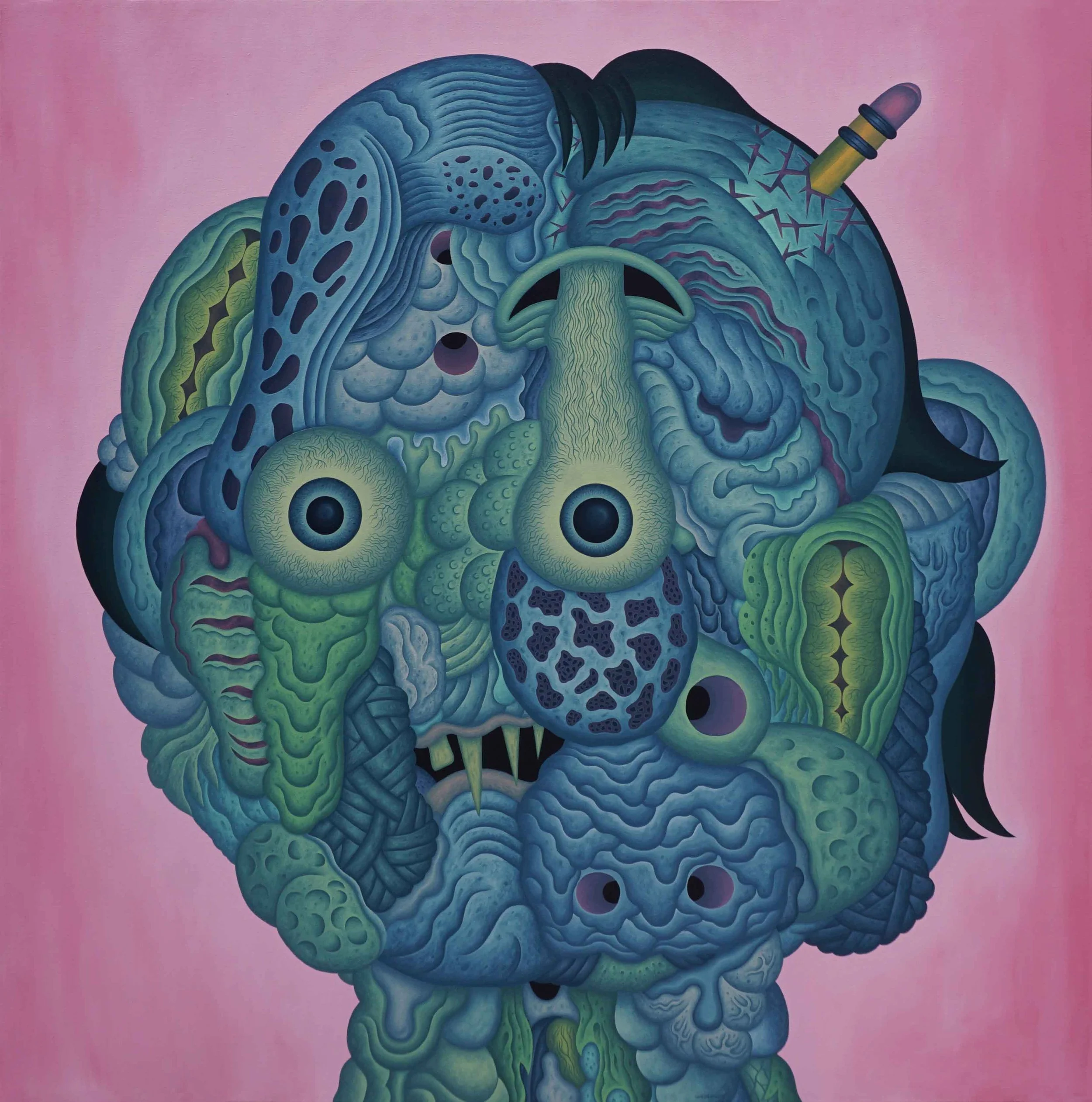
“Blasé” by Louie Cordero. Acrylic on canvas. 72 x 72 inches. 183 x 183 cm.
The rest of Cordero’s portraits follow a similar pattern stylistically and thematically, albeit in a smaller scale. “The smaller paintings, almost measuring 27 by 27 inches, could qualify as a separate show…and may be viewed as quasi-portraits of characters who perhaps convey private turmoil apart from Cordero’s warm personality among friends and associates,” writes Torre.
The portraits offer concentrated moments to appreciate Cordero’s technique. Yet, the seven marker illustrations show the artist’s confidence and mastery when it comes creating these characters. One could even see when the artist paused through the line weight and detail.
Incorporating horror, critiquing pop culture
Brain Rot showcases Cordero’s foray into portraying a more subtle yet equally sinister monster encased in our screens. The solo show harkens back to media such as Black Mirror and other attempts at portraying a pessimistic vision of a technologically-driven future.
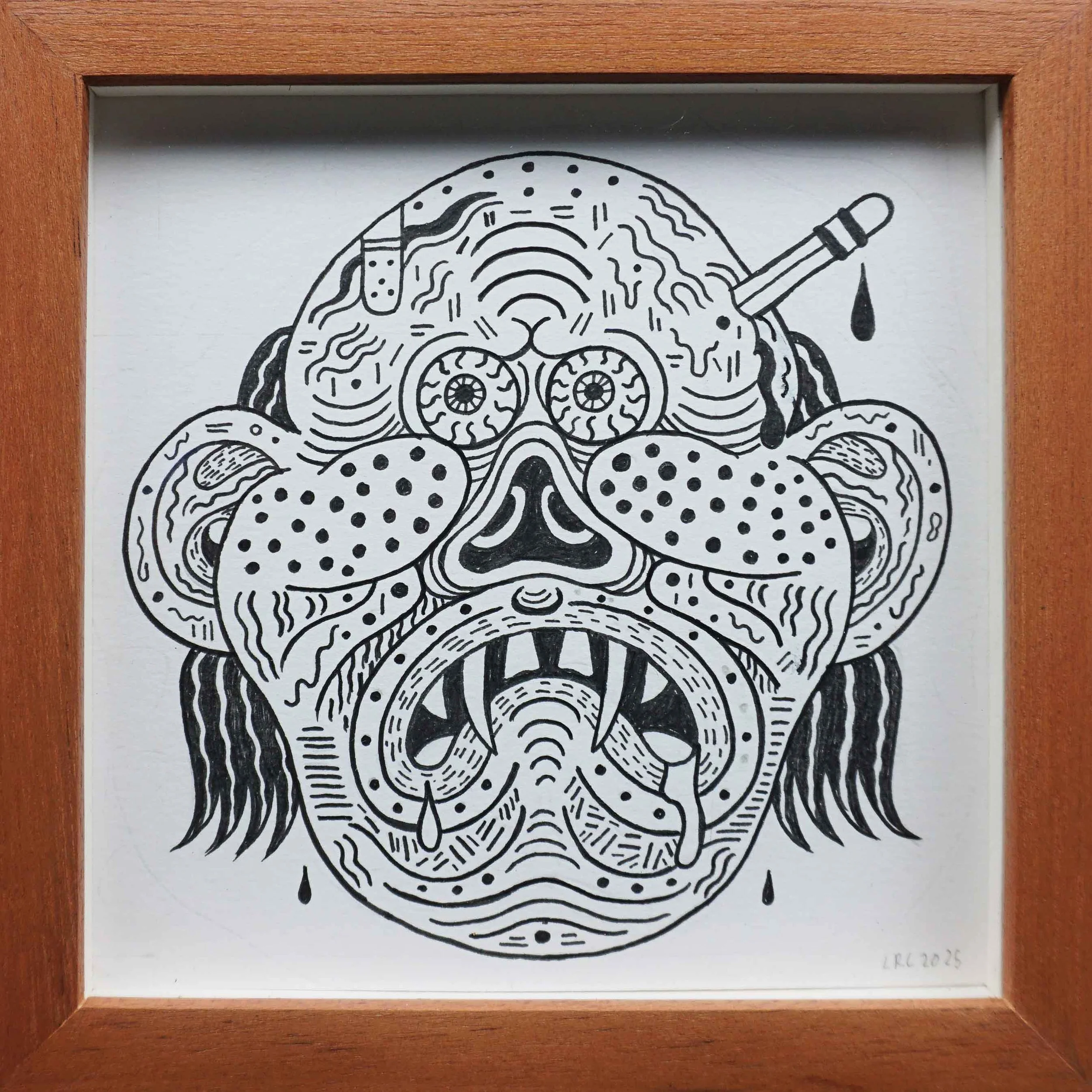
“Scrag” by Louie Cordero. Sharpie pen on paper. 6 x 6 inches. 15 x 15 cm.
Though, what distinguishes Cordero’s take on horror is his incorporation of kitsch and comic art. As mentioned before, these elements ground Cordero’s artwork in current events and pop culture. Though, more importantly, the garish qualities of kitsch give viewers a sensory hit—just like horror and so-called low-quality content.
“Exposure to terrifying acts, or even anticipation of those acts, can stimulate us—both mentally and physically—in opposing ways,” writes Johns Hopkins University researchers Haiyang Yang and Kuangjie Zhang in an article on the horror genre. “Negatively (in the form of fear or anxiety) or positively (in the form of excitement or joy).” By threading together horror and Internet content, Cordero makes the case that both insidiously operate in similar ways.
Brain rot’s effects—shortened attention spans, mental exhaustion, and passive consumption, to be precise—are concerning. These only scratch the surface of why brain rot is so sinister. Social media platforms curate and distribute content based on an individual’s preferences, thus creating echo chambers where people are not exposed to different view points.
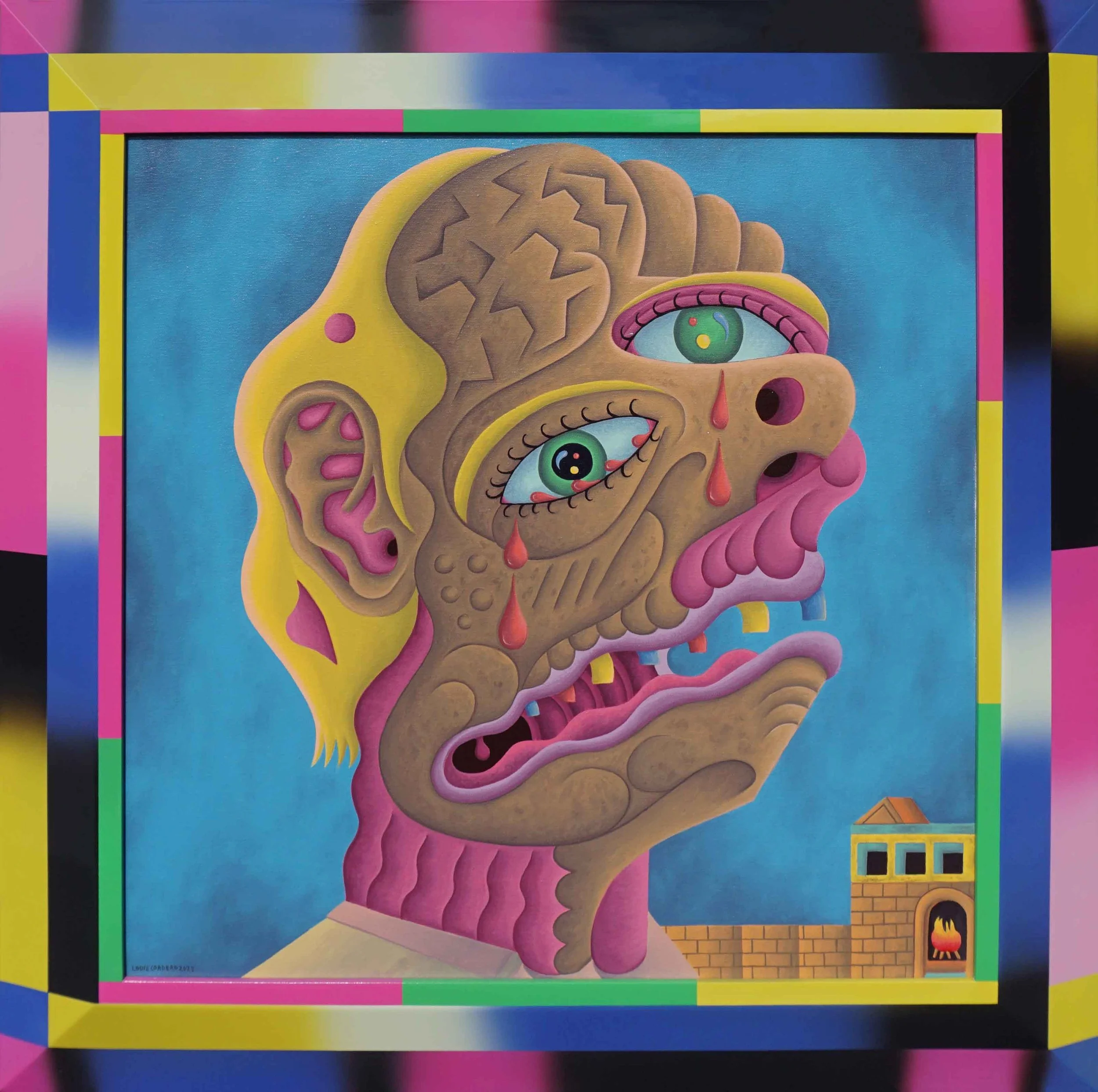
“Memorial crust” by Louie Cordero. Acrylic on canvas, automotive paint on wooden frame. 31 x 31 inches. 79 x 79 cm.
“A lot of people love reading things that fortify and confirm their own opinions,” says Harvard Law School Professor Cass R. Sunstein in an interview with Harvard Law Today. “If you listen to people like you, you’ll probably get more extreme and more confident too.”
Low-quality online content isn’t simply low-quality because of amateur production value and pixelated videos. In fact, a number of influencers create polished and engaging videos under a minute long. What’s questionable about brain rot content is not the content itself, but how it’s shared through algorithms engineered to deliver information quickly and keep users on these platforms. The artist compresses this into portraits of unsightly characters.
The cure for brain rot
In his solo show, Louie Cordero makes a case that brain rot is the latest disease ailing modern civilization. He draws from a myriad of influences, such as kitsch, the horror film genre, Futurism, and Cubism, and evolves his own practice. Cordero successfully surveys and captures pop culture at large, though the topic of brain rot, like most maladies, requires a deeper diagnosis.
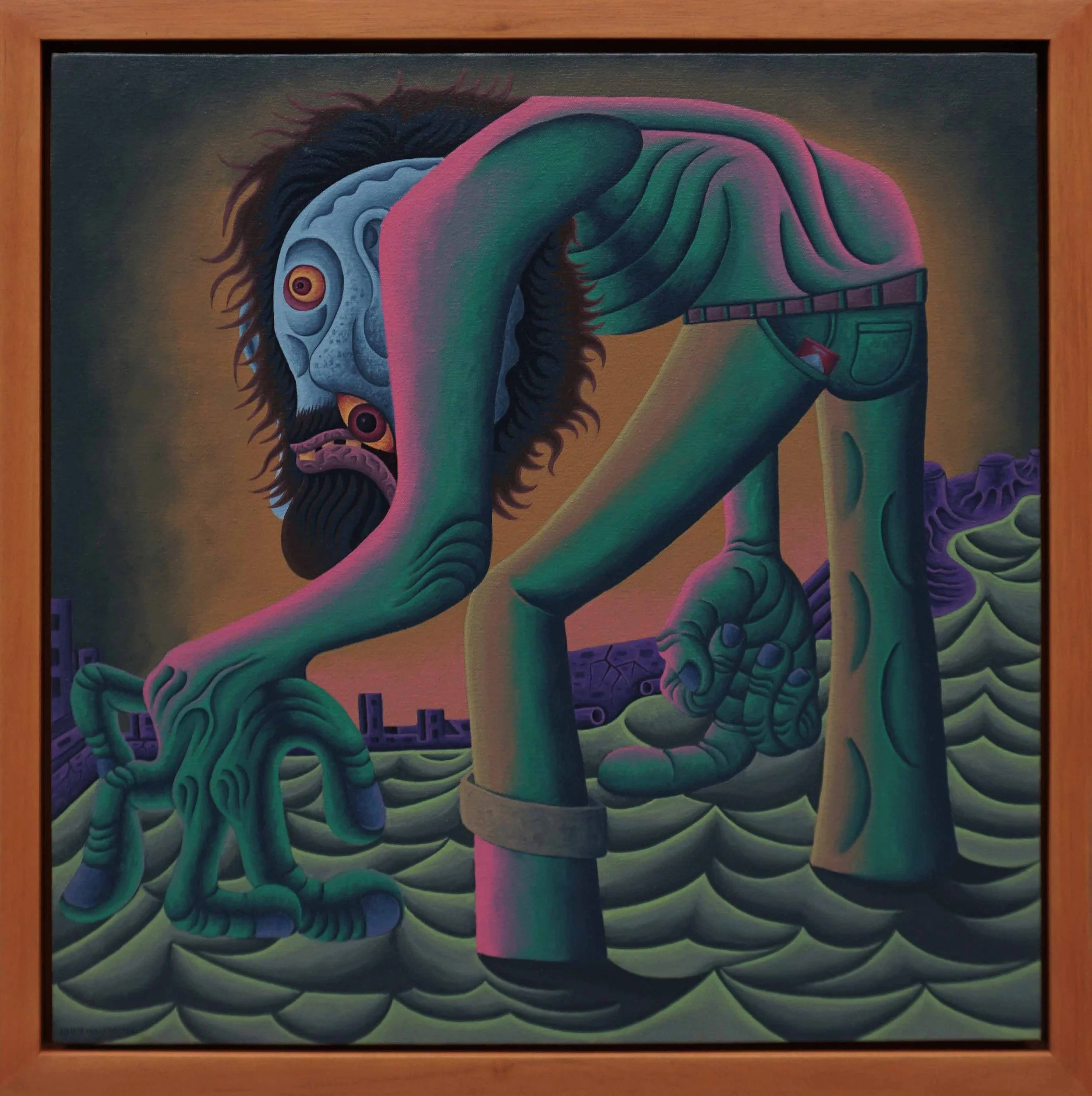
“Culture of corruption” by Louie Cordero.
Brain rot is not an affliction, but rather a symptom of a myriad of issues today. According to the World Health Organization, 1 in 6 people are affected by loneliness, which has dire consequences such as the higher likelihood of early death. The number of working hours increased, especially with the advent of 9-9-6, which gained popularity in China and is slowly spreading to Silicon Valley. The rising need for connection and dwindling leisure time could trigger people to turn to thirty-second videos of strangers dancing in their bedrooms.
What’s the cure? By mounting an exhibition centered on this insidious phenomenon, Cordero hints that spending time with art to recalibrate attention spans and take time away from screens. Perhaps, like a good painkiller, this manages the symptoms but doesn’t fight the root.
Sources:Bakal, J. (n.d.). Unknown Memory: Louie Cordero | Mo_Space. Retrieved November 18, 2025, from https://www.mo-space.net/exhibitions/unknown-memory-louie-cordero-mo-spaceBarnhart, B. (2025, November 14). 28 TikTok statistics marketers need to know in 2025. Sprout Social. https://sproutsocial.com/insights/tiktok-stats/#:~:text=5.,not%20multiple%20times%E2%80%94per%20day.Gordon, I. (1995). Mass market modernism: comic strips and the culture of consumption. Australasian Journal of American Studies, 14(2), 49. https://www.jstor.org/stable/41053781